We believe that health professionals who understand the importance of carers’ involvement can effectively support carers, and support recovery.
Carers are so often forgotten in the discussion around eating disorders, and when carers are supported and have connections with others, they can more effectively support their loved one to recover.
This is why we are now including clinicians in being able to access past webinars.
Access to the subscription service costs AU$75 annually. Your account details will be stored and will be charged on an annual basis from the date of purchase.
Subscription accounts cannot be shared with others, and each provider must purchase their own subscription.
To access this service, you will be asked to answer a few questions about your professional role. You will receive a Welcome Email following your payment receipt.
If you don’t receive it, please check your junk mail (and add EDFA to your safe senders list).
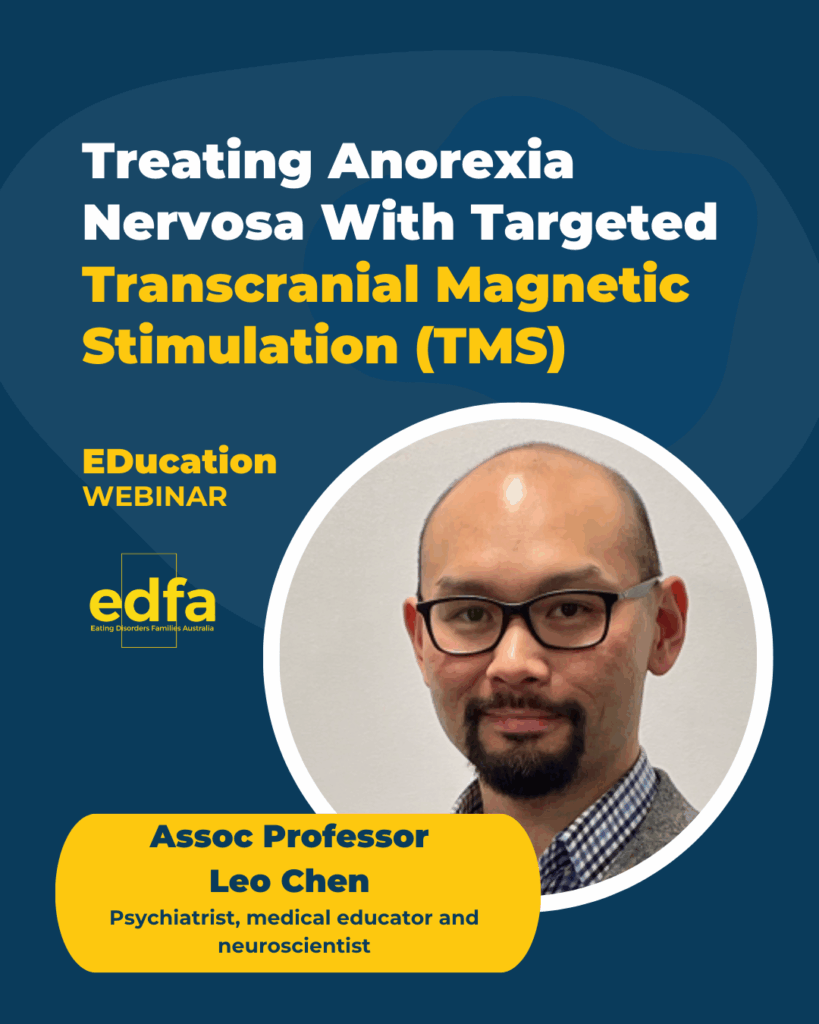
TMS is a safe and non-invasive form of brain stimulation that can modulate regional brain activity and downstream networks. Using causal lesion network mapping, Dr Chen and his team derived a casual brain network for anorexia behaviours, and designed a first of its kind, proof of concept clinical trial applying TMS to an individualised cortical target connected to this causal network. The aim is to offer a novel, effective and easily tolerated treatment for persons living with anorexia nervosa. Further investigation is underway.
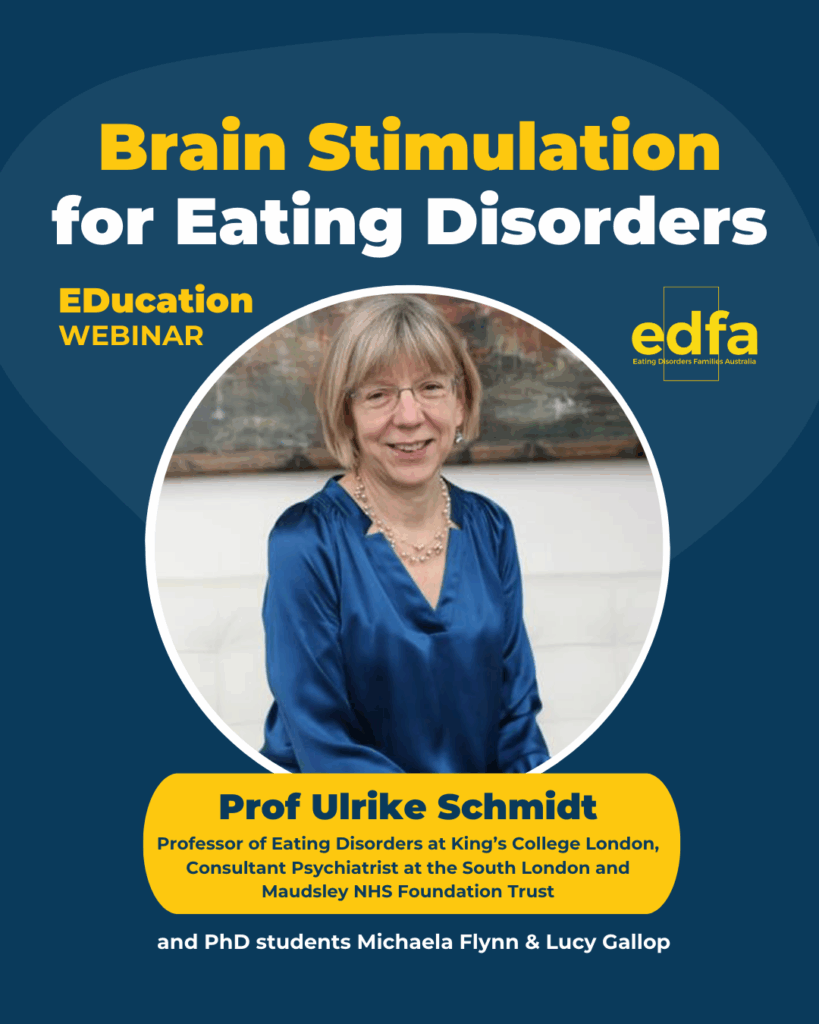
This webinar outlines the effectiveness of brain stimulation for eating disorders: a safe, precise and targeted brain surface hemisphere stimulation which enhances neuroplasticity and facilitates new learning.
Dr Guadiani explores the medical complications associated with eating disorders. Dr Guadiani also wrote the book Sick Enough, which aims to improve medical diagnosis and treatment, motivate recovery, and validate the lived experiences of individuals of all body shapes and sizes, while firmly rejecting diet culture.
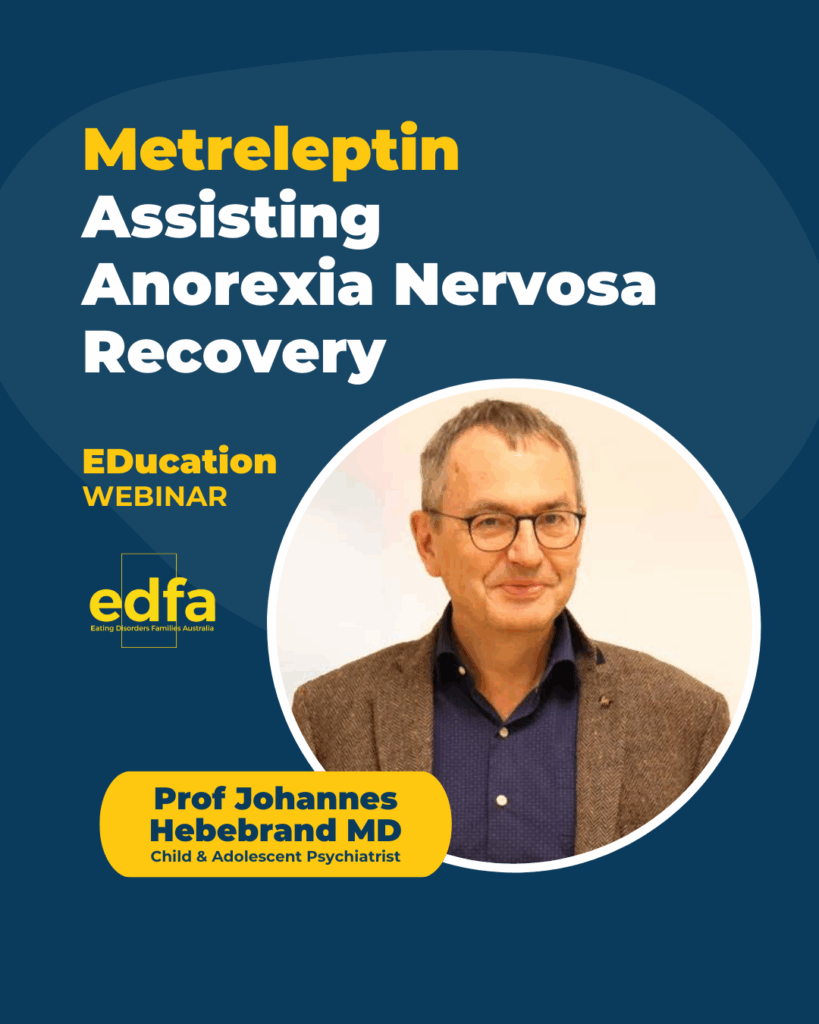
Professor Hebebrand’s research addresses the use of off-label treatments of patients with human recombinant leptin (metreleptin). Preliminary research shows that participants with Anorexia Nervosa have been found to reduce depression and the need to exercise.
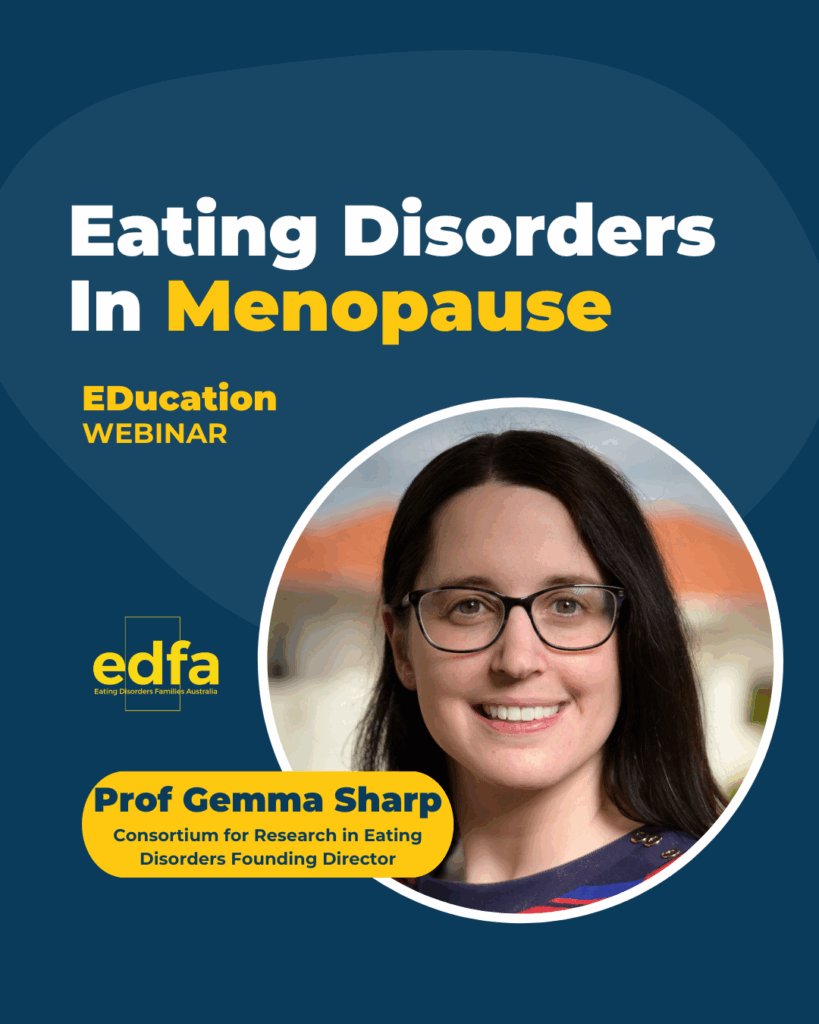
There is very little research on the eating disorder experiences of people in midlife. From the limited available research, it appears that menopause, like puberty, is a key risk period for exacerbation, re-emergence and new onset of eating disorders owing to a range of biological, psychological and social factors. Professor Sharp led the co-design and development of a world first online program addressing the intersection of eating disorders and the menopause transition in collaboration with Eating Disorders Victoria.
Copeland’s research focuses on the lived experience of ARFID in an Australian treatment context, and the provision of CBT-AR led by a dietitian. This webinar focuses on the lived experience of EDFA carers, including supporting those with ARFID at home and resources currently available.
In this webinar, Elizabeth talks about the importance of connection, compassion, person-centred and trauma-informed care for people with eating disorders, with a focus on how families can be more compassionate in their support during treatment at home. As a counsellor and psychotherapist, in addition to her own experience supporting her child through an eating disorder many years ago, Elizabeth brings forward her dual clinical and lived experience perspective. Elizabeth explores strategies and practices that can enhance a loved ones’ healing and recovery, as well as their own wellbeing.
Elizabeth is a registered counsellor and psychotherapist specialising in working with young people and their families. With a professional interest in bringing together creativity and lived experience, Elizabeth takes an integrative approach, including person-centred, behavioural, cognitive, psychodynamic, and mindfulness theoretical orientation.
Elizabeth’s first book ‘The Disappearing Sister’ has gained attention for its simple explanation of eating disorders aimed at siblings and families. Elizabeth writes poetry and won the HARP Writers’ Prize in 2015 for a poem about gender and identity. The latest picture book, The Forever Kid (Big Sky Publishing; October 2018) deals with themes of grief and remembrance.
An eating disorder is a crisis affecting the individual and their family. Dr Suzy Redston discusses how to manage the eating disorder crisis, including the medical, psychiatric, social wellbeing and disruption to day-to-day life. Suzy explores how carers can plan in advance for crisis management, and how to use resources at hand.
Crisis management can include starting difficult conversations, dealing with hospital admissions or physical violence, or suicide and self-harm. This is an important webinar for ensuring the safety and wellbeing of those with eating disorders.
Dr Redston specialises in comprehensive assessment and holistic treatment for individuals experiencing eating disorders and trauma-related mental health conditions. As a Fellow of the Royal Australian and New Zealand College of Psychiatrists, she has dedicated her career to advancing psychiatric education, training registrars, and mentoring in psychotherapies. She holds an advanced training certificate in psychotherapy, reflecting her commitment to expert practice.
With extensive experience in public psychiatry, Dr Redston has held various clinical and leadership roles, contributing to the development of innovative and effective mental health services. Currently practicing full-time in the private sector, she continues to focus on her areas of expertise, advocating for evidence-based approaches to treatment and recovery. Her dedication to improving patient outcomes and advancing mental health care underscores her professional approach.
Given the link between eating disorders and Autism Spectrum Disorder (ASD), many eating disorder clinics now routinely screen new patients for autism to adapt treatment to the patient’s individual needs. People with ASD can present with a wide array of eating difficulties, and not just restrictive eating.
Jenny Langley shares how families and clinicians can work together to create appropriate and supportive adaptations, and how the New Maudsley Carer Skills approach can help support individuals with an eating disorder and autism.
Jenny Langley is a UK Lived Experience Carer Coach & Trainer, and author of ‘Caring for a loved one with an eating disorder.’ Since her son recovered from anorexia over fifteen years ago, Jenny Langley has campaigned to raise awareness of eating disorders and the impact on the whole family, and to provide practical help and support to families affected by eating disorders.
Jenny has worked closely with the Eating Disorder Research team of The Institute of Psychiatry for over ten years, and is trained in the New Maudsley Model. She has become an “experienced carer” coach for the research programs and delivers regular skills workshops for carers, as well as training for facilitators.
Anorexia Nervosa is an incredibly serious illness, with mortality rates up to 20% from medical complications and suicide. Associate Professor Warren Ward shares his extensive knowledge of the medical complications from eating disorders, and particularly Anorexia Nervosa. In this webinar, Warren presents his three goals of treatment: keeping the patient alive, reversing the cognitive effects of starvation, and psychotherapy. Some of the topics include abnormal blood results, postural hypotension and heart rate changes, refeeding syndrome and the effects on menstruation.
Warren Ward is an Associate Professor at the University of Queensland, an inaugural Medical Director of Wandi Nerida, Director of the Queensland Eating Disorder Services (QuEDS), and Director of Eating Disorders at Ramsay Clinic New Farm.
Warren is the co-author of the RACGP ‘Clinical Practice Guidelines for Eating Disorders’, and co-author of ‘Renourish: A complete and compassionate guide to recovery from eating disorders’ (2025) with Lexi Crouch.
Associate Professor Warren Ward shares his extensive knowledge of eating disorders and common comorbidities, including anxiety, depression, and ADHD. This webinar captures the complexities of prescribing medications for eating disorders with the small amount of data on their effectiveness, as well as how psychiatric medications can be used alongside psychological treatments to support eating disorder recovery.
Warren Ward is an Associate Professor at the University of Queensland, an inaugural Medical Director of Wandi Nerida, Director of the Queensland Eating Disorder Services (QuEDS), and Director of Eating Disorders at Ramsay Clinic New Farm.
Warren is the co-author of the RACGP ‘Clinical Practice Guidelines for Eating Disorders’, and co-author of ‘Renourish: A complete and compassionate guide to recovery from eating disorders’ (2025) with Lexi Crouch.
We invite you to further your understanding of the lived experience journey and challenges arising from being a carer.
Three incredible mothers share their experience supporting their daughters through Anorexia Nervosa. They share the struggles, wins and hope for others sharing the experience.
Two siblings will discuss the challenges they encountered, how it impacted them, the changes in family dynamics, the way they coped, what their role was, their learnings and reflections for parents, carers, and others, and where they are now.
Supplementary resources: Our Sibling Toolkits are wonderful resources to support parents raising other children, and children needing support if their sibling has an eating disorder.
This is a valuable opportunity to learn firsthand about the sibling experience and to hear their perspectives and insights, as well as understand more how we can support them in the best way.
Professor Genevieve Pepin shares her research on carers of those with eating disorders. The caring role can lead to harmful effects on their physical and mental health, which can similarly be seen in individuals with PTSD.
Carolyn Costin shares her lived and professional expertise. Recovered herself and treating eating disorders since 1979, Carolyn was first to speak out that people with eating disorders can become fully recovered.
Fifteen years into private practice and after running hospital units, Carolyn, unhappy with the relapse rate, recognised a need and opened Monte Nido, the first eating disorder residential facility.
Is Hay from Roses in the Ocean brings their lived experience of eating disorders and suicide, as both a carer and consumer. Is explores the intersection between suicide and eating disorders, what carers should know and be aware of, what options there are for support, and the impact that caring for someone with an eating disorder and suicidality can have on a carer.
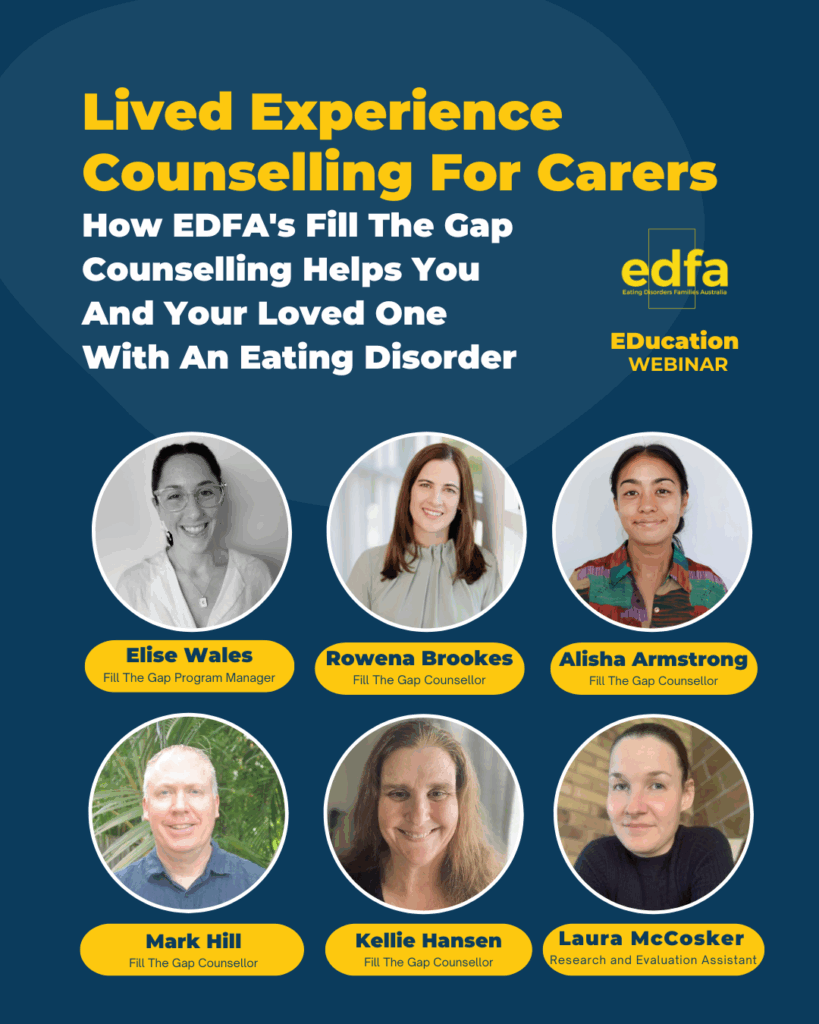
Carers have a critical role in eating disorder recovery, and as a result, carers often experience significant physical and emotional distress. EDFA’s Fill The Gap Counselling (FTG) service was established in 2023 to address the lack of targeted, specialised, lived-experience informed support.
This webinar will introduce the FTG counsellors, an overview of the service’s evaluation (qualitative and quantitative), and goals for growth and improvement. The webinar will also explore how counsellors support carers, including the unique challenges facing different types of carers, and where they are at in the recovery process.
Sally McAuliffe is a Brisbane-based mum of five, with children ranging in age from fifteen to twenty. After taking time off to support her daughter, Sally now volunteers at EDFA, facilitating Carer Support Groups.
Sally shares her family’s expertise with Anorexia Nervosa after her youngest daughter was diagnosed at age thirteen while at boarding school. Sally developed a home-based, FBT-style approach to treatment with minimal external support. She speaks about the difficult decisions her family had to take, including relocating, and offers practical insights and tools she learned along the way.
Sally reflects on what got her through some of the darkest days to the things she looks back on now and can laugh about. Eighteen months after diagnosis, Sallie’s daughter is thriving in recovery and her favourite food is Dubai chocolate.
Jenny Langley delivers skills-based training to carers of loved ones with an eating disorder. In this webinar, Jenny shares fundamental skills for carers whose loved ones have any type of eating disorder. As the involvement of families can help facilitate recovery, these skills can be helpful for health professionals who are working with families and supporting them in developing their own approach to refeeding their loved one.
Jenny Langley is a UK Lived Experience Carer Coach & Trainer, and author of ‘Caring for a loved one with an eating disorder.’ Since her son recovered from anorexia over fifteen years ago, Jenny Langley has campaigned to raise awareness of eating disorders and the impact on the whole family, and to provide practical help and support to families affected by eating disorders.
Jenny has worked closely with the Eating Disorder Research team of The Institute of Psychiatry for over ten years, and is trained in the New Maudsley Model. She has become an “experienced carer” coach for the research programs and delivers regular skills workshops for carers, as well as training for facilitators.