
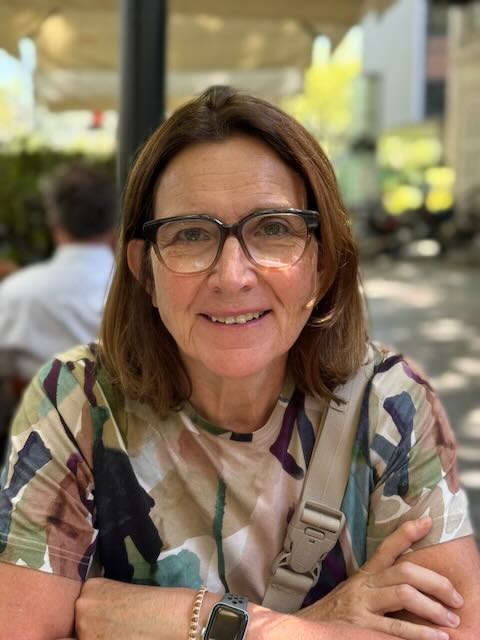
Hearts Behind the Hope: Meet Shirley (EDFA Volunteer)
Meet Shirley: Kind, loyal and enviably calm in a crisis.
Ask anyone who knows Shirley to sum her up in three words and the answer arrives without hesitation…. kind, loyal, talkative. Spend five minutes in one of her groups and you’ll see why nobody needed to think twice.
She came to Eating Disorders Families Australia (EDFA) by the route most of our beautiful volunteers do… she lived it first. There is, she says, a particular pull that arrives once you’ve been through an eating disorder journey and come out the other side. An urge to hand back even the smallest scrap of what you learned because you know precisely how heartbreaking the climb was. She has a metaphor for it, and it’s a good one – recovery, she says, is a string of fairy lights. Not linear. A bulb goes dark now and then. You just need to know which one to jiggle and when you do they all shine little stars of joy.
Recovery as a string of fairy lights
Facilitating with carer groups has taught her to put down the urge to solve people’s problems and just sit with them instead. She likens it to pregnancy …ask any pregnant woman who’s been told what she “should” be doing by twelve different people and she’ll tell you the same. Every carer must work out what’s right for their own family, their own version of this journey, their loved one’s comorbidities and personality… and no specialist, however qualified, can hand over a cookie cut pathway of recovery. What actually helps is connection. Carers on this particular journey, in Shirley’s experience, are lonelier than almost anyone realises and simply knowing someone else is walking the same heart-breaking emotional road turns out to be its own kind of medicine.
The best advice she ever received and the one she now hands on herself, is disarmingly simple: love them fiercely. Say it out loud, even and especially when their behaviour makes that feel impossible. Externalise the illness from the loved one, “I don’t love the way the eating disorder is talking to me but I love you. And let the carers’ group be the one place you’re permitted to say the less flattering truth to with people who comprehensively understand the tribulations “I’m finding it hard to like them today” because whatever they’re putting you through, their own head is putting them through something considerably worse.

The moments that stay with her
What stays with her are the exits. When carers leave a session and tell her she’s given them hope, relationships that seemed unsalvageable slowly finding their way back just from Shirleys story of her own journey. Her own relationship with her loved one, she notes with determined clarity, is intensely stronger now than it ever was before any of this started.
If she could correct one misunderstanding, it would be the seriousness of this disorder. Many still treat eating disorders as a matter of choice. Shirley would love that a greater understanding of the illness was wider spread and that carers fully understand the illness needs to be met early, fast and with the full weight of a multi-disciplinary team behind it.
Away from EDFA, she keeps a passport well-used (Bhutan being the highlight) eats her way determinedly through anything Southeast Asian or Japanese, is happy on the snowcapped slopes and shares her home with an anxious schnoodle that was meant to be her daughter’s temporary lockdown project and of whom she has become the primary carer for post COVID. It was never going anywhere.
Finding calm in the crisis
Ask what keeps her steady and she credits her husband not, by her own account, a natural at supporting her support her daughter but someone who worked out fast that his job was simply to be there. Since then, through crises of various shapes, Shirley has quietly become the calm one… the person who’s learned, the hard way, that the fastest way to settle someone else down is to be maddeningly regulated yourself.
“It’s so, so hard, like really hard but just hang in there. Use every resource you can, you’ll need them all, try everything. You don’t know which one might be the key but know there’s a combination out there that will work.”
Additional resources:
The needs of carers: a comparison between eating disorders and schizophrenia (2008)
The experience of living with a person with an eating disorder: the impact on the carers (2005)
Gender differences in caregiving among family – caregivers of people with mental illnesses (2016)
Eating Disorders Families Australia (EDFA) provides support and services for carers supporting loved ones with neurodivergence and an eating disorder.
EDFA’s Men’s Support Group is open to any carer identifying as male, including dads, partners, siblings, and friends, who are supporting a loved one with an eating disorder. The group is held every two months in the evenings, providing a safe space to connect, share experiences, and gain support from other males who understand.
EDFA’s Fill The Gap counselling service offer free, one-on-one online counselling to support carers in navigating the challenges of caring for a loved one with an eating disorder or disordered eating concerns.
Please contact Administrative Assistant, Bailey Wightman, on 03 9125 5670 or email counselling@edfa.org.au if you need support accessing the service.
About Eating Disorders Families Australia
Eating Disorders Families Australia (EDFA) is the only national organisation solely for carers and families of those with an eating disorder. EDFA provides support, EDucation, advocacy, and FREE online counselling services and annual membership. EDFA has a private Facebook forum, providing a safe place for eating disorder carers and family members to share experiences, seek advice and assistance, and find hope.